 IMPERIAL GROUP INCORPORATED
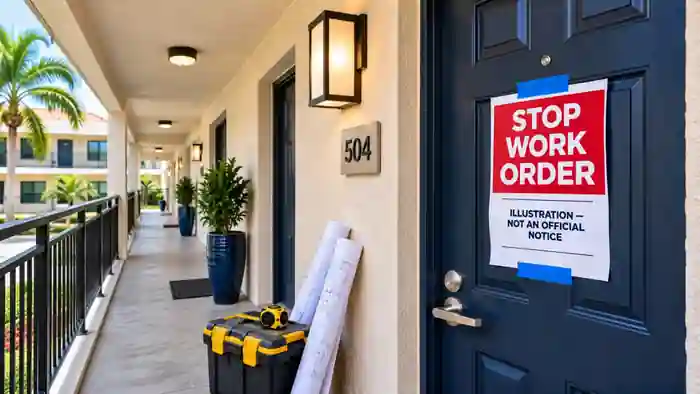
First, Let's Address the Elephant in the Room!
Yes, we know.
“STOP WORK ORDER” is only THREE words!
Apparently, someone at Imperial Group needs a refresher course in elementary mathematics!
But now that we've got your attention, let's discuss something considerably more expensive than our questionable counting skills.
Because those three little words, when issued by your local building official, can turn an exciting renovation into a financial nightmare. And unlike our mathematical mistake, this one might not be something you can laugh off.
Your Neighbor Got Away With It. Will You?
Let's be honest. Somewhere in South Florida, a homeowner is renovating a bathroom, modifying plumbing, replacing electrical wiring, or installing windows without obtaining a required permit.
The work gets completed. Nobody complains. No building inspector comes knocking. Life goes on.
Does that make it legal? Absolutely not. It simply means the violation hasn't been discovered or addressed.
Now imagine attempting the same thing inside a condominium. Congratulations! You've just entered an entirely different world.
A world of condominium associations, property managers, architectural review committees, building inspectors, shared plumbing systems, common walls, and concerned neighbors.
In a detached single-family home, many construction problems initially affect one household. In a condominium, one mistake can affect people above you, below you, and beside you.
Important: Not every renovation requires a government permit. Painting and certain cosmetic improvements may be exempt. However, condominium projects can be subject to different requirements, and even permit-exempt work may require association approval.
Your Condo Is Yours. The Building? Well, That's Another Story!
Owning a condominium doesn't give you unlimited authority to alter everything behind your front door. Some building components belong to or serve the condominium community, and your unit is subject to the declaration, governing documents, and applicable laws. Here's why that matters.
- Plumbing and waterproofing. An improperly installed shower drain, leaking supply line, or defective waterproofing system can send water through ceilings and walls into neighboring units. Your $15,000 bathroom renovation could become a much larger repair bill.
- Electrical systems. Faulty wiring or improperly modified circuits can create electrical shock and fire hazards affecting more than your unit.
- Structural components. That wall you want to remove might not be as innocent as it looks. Structural slabs, load-bearing walls, and other shared elements require appropriate evaluation and approvals.
- Flooring and noise. Replacing carpet with tile may look beautiful until the neighbor below discovers that your footsteps sound like a marching band rehearsing at six o'clock every morning. Condominium associations frequently have sound-control requirements. Some municipalities, including Miami Beach, require permits and inspections for certain condominium flooring projects.
- Fire protection. Alterations affecting fire-rated assemblies, smoke detectors, sprinkler systems, and fire-safety components can endanger multiple households.
- Air conditioning and ventilation. Changes to mechanical systems may affect shared equipment, condensate drainage, or surrounding units.
- Windows and exterior doors. Hurricane-impact installations require attention to product approvals, structural attachments, local permitting, and association responsibilities.
The bottom line: In a condominium, one owner's construction mistake can become an entire building's problem.
Meet Your Other Building Inspectors: The Neighbors!
Let's discuss something that doesn't always appear in the contractor's estimate. Your neighbors.
Some are genuinely concerned about safety. Others want to protect their investments. Many have experienced construction problems before and have absolutely no intention of going through that again.
And then there's THAT neighbor! You know the one. The neighbor who somehow sees everything happening in the building.
Nothing escapes their attention. Not the delivery truck. Not the contractor carrying his tools. And certainly not those beautiful kitchen cabinets being unloaded outside.
They approach you with the warmest smile.
“Good morning! How are you? Oh, I see you're doing some renovations! What are you having done? Are you replacing the plumbing too? Did you get new windows?”
What a lovely conversation! Such a friendly, interested neighbor.
Well, don't be too surprised if that delightful conversation becomes a detailed report to the condominium association before you've finished your morning coffee!
And here's where things become particularly interesting. That friendly, curious neighbor might actually be a member of the condominium board!
The same person admiring your beautiful new tiles might be reviewing your renovation paperwork at the next board meeting. And if they suspect unpermitted construction or unsafe work, they may contact the city's building department or code enforcement office directly.
Suddenly, your friendly hallway conversation has produced some very official questions.
Congratulations! Your building has its own unofficial inspection department — and apparently they're open seven days a week!
Now, let's be clear. Neighbors have every right to raise legitimate safety concerns. They're protecting their homes and investments, just as you should protect yours.
The lesson isn't to hide your project or avoid friendly neighbors. The lesson is to make sure your permits, association approvals, and contractor documentation are in order before the first hammer swings.
Because when everything is done properly, you can smile, answer those questions, and enjoy the renovation.
Two Approvals, Two Different Authorities
Many condominium renovations involve two separate approval processes.
- Condominium association approval. Depending on the governing documents, this may require an architectural review application, contractor licensing and insurance, plans, material specifications, construction deposits, elevator reservations, and compliance with work-hour restrictions.
- Local building department approval. Your city or other permitting authority determines whether the project requires building, electrical, plumbing, mechanical, or other permits, along with inspections and final approvals.
Association approval does not replace a government permit. A government permit does not automatically override association rules. You may need both. And for changes involving common elements, additional legal and association approval requirements may apply.
Florida's New 2026 Permit Exemption: There's a Catch!
Effective July 1, 2026, Florida established a permit exemption for certain qualifying projects valued at less than $7,500 on single-family residential property.
Under Florida Statutes Section 553.79(1)(g), the exemption has conditions:
- The work must qualify under the single-family dwelling provision.
- The project value must be below $7,500.
- Electrical, plumbing, structural, mechanical, and gas work are excluded.
- The property cannot be partly or entirely within a defined flood hazard area.
- The owner or contractor must submit a written exemption request with supporting documentation.
- A larger project cannot be divided into smaller projects to evade permitting requirements.
The City of Fort Lauderdale specifically explains that this new exemption does not cover condominiums, apartments, or multifamily buildings.
So a qualifying improvement at a single-family home may be eligible for an exemption while comparable work in a condominium faces different permitting requirements.
But don't misunderstand: This does not mean every small condominium improvement automatically needs a permit. Existing exemptions and local requirements still matter. Ask the building department before beginning.
But I Own My Condo! Can't I Pull My Own Permit?
Here's another important distinction. Under Florida Statutes Section 489.103(7), certain owners of qualifying one-family or two-family residences may act as owner-builders, obtain permits, supervise construction themselves, and accept the associated legal and financial responsibilities.
That ordinary owner-builder exemption does not generally apply to individual condominium units.
For typical permit-required condominium renovations, the appropriate licensed contractor or licensed trade professional must ordinarily obtain the relevant permits.
There is a narrow exception allowing an owner, with local permitting agency approval, to complete the requirements of an existing permit after the contractor listed on that permit has substantially completed the project. That is not permission to begin an ordinary condo renovation as an unlicensed contractor.
A business card, a toolbox, and the statement “I've been doing this for 30 years” are not substitutes for proper licensing.
You've Got Mail! And This Time, It's Not a Love Letter.
Picture this. Your bathroom renovation is progressing beautifully. The tiles are arriving. The cabinets are almost installed. You're already imagining the finished project.
Then you return to your condominium and notice a piece of paper attached to your front door. Perhaps it's orange. Maybe white, blue, yellow, or red. The appearance depends on the jurisdiction and notice type.
For a brief moment, you wonder whether someone has left you an invitation. Well, congratulations!
You may have received an unpleasant love letter from your local building department or code enforcement office.
Yes, the same THREE words we apparently couldn't count at the beginning of this article!
Under Section 115 of the Florida Building Code's administrative provisions, a building official may issue a stop-work order when regulated construction violates applicable code provisions or is dangerous or unsafe. The written order states the reason and the conditions under which work may resume.
The affected work must stop when the order takes effect. Unauthorized continuation can lead to additional penalties.
Your contractor's schedule? Interrupted. Your material deliveries? Suddenly inconvenient. Your completion date? Looking increasingly optimistic.
And the money you thought you saved by avoiding the permit? That savings account may be about to develop a serious leak!
When Saving Money Becomes Very Expensive
The consequences vary by jurisdiction and situation, but they can be substantial.
1. Higher Permit Fees
Some governments impose higher charges when work begins without required permits. Miami-Dade County explains that qualifying work subject to a Notice of Violation may incur an additional fee equal to 100% of the normal permit fee — effectively doubling it. The City of Delray Beach states that its after-the-fact permit cost is tripled. These are jurisdiction-specific examples, not statewide automatic charges.
2. Daily Code Enforcement Fines
Under Florida Statutes Section 162.09, applicable code enforcement proceedings may result in fines of up to:
- $250 per day for an initial violation.
- $500 per day for a repeat violation.
Qualifying larger counties and municipalities that have adopted the required ordinance may authorize higher limits:
- Up to $1,000 per day per violation for an initial violation.
- Up to $5,000 per day per violation for a repeat violation.
The law also provides for separate penalties for certain irreparable or irreversible violations. These are maximum authorized amounts, not automatic fines. Enforcement procedures, hearings, deadlines, and applicable local ordinances determine what may actually be assessed.
3. Liens Against Property
Under Section 162.09, a properly recorded government code enforcement fine order can create a lien against the property involved and certain other property owned by the violator. Florida law provides important protections, including restrictions against foreclosure of such liens on qualifying homestead real property. Nevertheless, unresolved liens can create significant legal and financial complications.
4. Tearing Out Completed Work
Imagine installing beautiful bathroom tiles only to learn that concealed plumbing or waterproofing must be exposed for inspection. That may require demolition, professional evaluations, repairs, additional inspections, and rebuilding finished surfaces.
Paying once for a renovation is understandable. Paying twice for the same renovation? That's a very expensive lesson.
5. Condominium Association Penalties
Associations may enforce their governing documents and impose authorized fines. Under Florida Statutes Section 718.303, association fines generally may not exceed $100 per violation or $1,000 in the aggregate for a continuing violation. The law requires appropriate notice and a committee hearing process before a fine is imposed.
Importantly, association fines themselves do not become liens against condominium units. Government code enforcement liens and condominium association fines are separate legal matters.
6. Other Costs and Complications
The consequences may also include property damage liability, insurance coverage disputes, association enforcement proceedings, legal expenses, professional engineering fees, correction or removal of noncompliant work, extended construction delays, and complications during a future property sale.
Insurance claims are not automatically denied solely because work was unpermitted; coverage depends on the policy and circumstances. The point is simple: an initially inexpensive shortcut can create a very expensive problem.
Ten Ways to Avoid an Unwanted Love Letter
Before beginning a condominium renovation:
- Read your association's renovation rules. Obtain the current written procedures.
- Confirm the permit requirements. Ask the local building department about your actual project scope.
- Verify your contractor's license. Use Florida's official DBPR licensing search.
- Check insurance documentation. Confirm the coverage required by the association and applicable law.
- Get a detailed written contract. Clearly assign responsibility for permits, inspections, materials, and subcontractors.
- Secure all necessary approvals. A submitted application is not the same as an issued permit.
- Protect shared systems. Address plumbing, waterproofing, noise control, fire protection, and structural requirements.
- Follow building procedures. Respect approved work hours, elevator rules, access requirements, and debris restrictions.
- Schedule required inspections. Do not cover work that requires inspection before authorization.
- Close the permits and save your records. Keep permits, approved plans, inspection results, association authorizations, and warranties.
When someone says, “Don't worry, nobody ever checks,” that's exactly when you should start checking!
Already Received a Stop-Work Order? Here's What to Do.
First, don't panic. Many violations can be corrected, but ignoring the order usually makes matters worse.
- Stop the affected work. Follow the order immediately. Only perform corrective or safety work the authority permits.
- Contact the issuing department. Obtain the violation details, deadlines, instructions, and requirements for resuming work.
- Notify the condominium association. Determine whether separate association violations or approvals must also be addressed.
- Engage a qualified licensed contractor. The existing work may require evaluation by an architect or engineer.
- Obtain the required permits and approvals. After-the-fact permits may be available, but approval is not guaranteed. Noncompliant work must be corrected.
- Arrange inspections and corrections. Be prepared to expose concealed work if necessary.
- Address enforcement proceedings. Respond to notices and hearing dates, and inquire about available extensions or fine reductions where allowed.
- Get authorization before resuming. Never assume submitting a new permit application automatically lifts a stop-work order.
- Close everything properly. Complete inspections, obtain required final approvals, and confirm that the violation has been resolved.
For serious liens, substantial fines, legal disputes, or allegations of contractor misconduct, consider consulting a Florida attorney experienced in construction or condominium law.
The worst strategy? Pretending the notice doesn't exist and hoping everyone forgets about it. Building departments have paperwork. Paperwork has records. And records have a remarkable memory!
The Final Word: Protect Your Investment and Your Neighbors
A condominium renovation should improve your home, enhance comfort, and protect your investment. It should not create safety hazards, damage neighboring properties, or turn your savings into permit penalties and legal expenses.
Permitting isn't simply about fees. It provides a framework for building safety, qualified construction, inspections, and accountability. And in a condominium, accountability matters because multiple families share the building.
Before swinging that first hammer, disconnecting that plumbing line, or removing that wall, ask one important question:
Do I have the approvals and permits required to do this properly?
Because the cheapest renovation isn't necessarily the one with the lowest starting price. It's the one completed safely, legally, professionally, and without expensive surprises.
Remember: A permit may cost you money today. Ignoring one could cost you considerably more tomorrow.
And if you happen to find a notice on your condominium door, let's hope it really is an invitation to the residents' holiday party!
A Message From Imperial Group Incorporated
At Imperial Group Incorporated, quality construction means more than beautiful finishes. It means responsible planning, appropriate permitting, code compliance, professional workmanship, and respect for neighboring properties.
Whether your project involves a bathroom renovation, kitchen remodeling, flooring, hurricane-impact windows and doors, or broader condominium improvements, understanding the rules before construction begins is an important step toward protecting your investment.
Planning a Condominium Renovation? Start With a Professional Conversation.
Request a Free Estimate →Serving South Florida, with a focus on Broward County · Call 754-444-2284
Official Sources and Further Reading
- Florida Statutes § 553.79 — Permits and the 2026 single-family exemption
- Florida Statutes § 489.103 — Owner-builder licensing exemption
- Florida Statutes § 162.09 — Government code enforcement fines and liens
- Florida Statutes § 718.303 — Condominium association fines
- Florida Attorney General Opinion 2023-01 — Owner-builder exemption
- City of Fort Lauderdale — 2026 permit exemption guidance
- Miami-Dade County — General permit information
- City of Delray Beach — Building Department FAQ
- City of Miami Beach — Condominium flooring permit guidance
- Florida DBPR — Verify contractor licenses
Educational notice: This article provides general information, not legal advice. Permit requirements, exemptions, enforcement procedures, fees, and condominium association obligations depend on current law, jurisdiction, and project scope. Confirm applicable requirements with the appropriate building department, condominium association, and qualified professionals.
Legal references reviewed November 1, 2026.